DVD and Blu-Ray Reviews
by Kyu Hyun Kim
This page contains reviews of DVDs and Blu Rays from across the world, of Korean films and other works related to Korea. Here we plan to cover DVDs and Blu Rays, classic and brand-new films, independent and blockbuster productions, deluxe special editions and cheapo bargain-bin releases (except for the flagrantly illegal versions) and all varieties of genres and formats including feature films, documentaries, short films and animation. The reviews themselves will focus as much on the presentation of the films as the films themselves, including, we hope, the issues usually neglected in other DVD reviews, such as the quality of English subtitles. Bon appetite!
List of Titles (in alphabetical order):
Barking Dogs Never Bite (DVD, Magnolia, Region 1)
Crossing the Line (DVD, Kino Video, Region 1)
Haeundae (a.k.a. Tidal Wave) (Blu Ray, Magnolia, Region Free)
I Saw the Devil (Blu Ray, Magnolia, Region A)
Marines Who Never Return, The (DVD, Bitwin, Region Free)
Mother (Blu Ray, Magnolia, Region Free)
Secret Sunshine (Blu Ray, Criterion, Region A)
Soonji (a.k.a. May Story) (DVD, Vanguard, Region 1)
Vengeance Trilogy (DVD, Palisades Tartan, Region 1)
Who's to Forgive Whom?: SECRET SUNSHINE [Blu Ray]
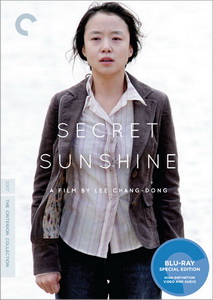 A Pine House Film Production, 2007. Distributed by CJ Entertainment & Cinema Service. South Korea. 2 hour 23 minutes. Written and directed by Lee Chang-dong. Based on a novel by Yi Chong-jun. Produced by Lee Hanna. Music composed by Chrisitian Basso. Cinematography by Cho Yong-kyu. Edited by Kim Hyun. Production design by Shin Jeom-hui. Costume design by Cha Sun-young, Kim Nuri.
Lee Chang-dong, a former high school teacher and novelist who entered the cinematic arena in his 40s, is a deceptively difficult filmmaker to classify. Lee's international reputation is well entrenched by now, but it is devoid of the kind of obsessive engagement, overheated rhetoric or deliberately fussy put-downs the works of Kim Ki-duk, Park Chan-wook or Bong Joon-ho sometimes inspire among critics, scholars and fans. Among Korean critics, at least since he accepted the post of Minister of Culture and Tourism under the controversial Roh Moo-hyun presidency, Lee seems to have been prematurely consigned to a pedestal whereupon he is duly respected if not venerated, but no longer considered cutting-edge or challenging, the reviews of his latest works sometimes accompanied by grumblings that they are not "cinematic enough."
Imprisoned by the moral rigor of the pro-realist agenda, many Korean critics of the '90s and early 2000's eagerly championed Lee's early works Green Fish (1997) and Peppermint Candy (2000), what with the then-astonishing naturalism of their performances, their airtight command of narrative structure and their gumption to poke at the improperly gauzed-over wounds of modern Korean history. So when Lee's works began to expand beyond the boundaries of social realism-- or to be exact, the social realism as cripplingly defined as the style exclusively approved by the morally righteous, (self-designated) left-wing intelligentsia-- to address moral complexities, individualistic desires and, most damningly, fantasies of his characters, some critics seemed to respond with, if not overt irritation, the kind of pert disappointment reserved for those whom they know are capable of doing "much better." Why is Lee Chang-dong, recognized as a world-class director, still making these conceptually hoary and aesthetically unrewarding "literary films" (munye yeonghwa) for the middlebrow audience?
It is more than a little ironical-- and this does hint at the narrow-mindedness of Korea's cultural intelligentsia, methinks-- that now that Lee Chang-dong is making movies that "fall beneath" the Euro-pedigreed, Deleuz-&-Guatari-addicted, thrashing-neoliberalism-at-every-turn discourse on the cinematic art that is the province of the hoity-toity and realistically address the actual lives of the ordinary Koreans (proletariat, petty bourgeoisie and whatnot), they become less interesting for the critics who used to champion "realism" as the only worthy criterion of cinematic excellence. The truth the way I see it? There is hardly any Korean filmmaker active today like Lee, whose cinematic works have shown consistent improvement, and ever more challengingly engaged with the emotional and material lives of "real" Koreans. Lee's Secret Sunshine (2007) and Poetry (2010) are simply superior to Peppermint Candy and Oasis (2002) in almost every way, not least because there is no other director in Korea who could squeeze so much mileage out of the most talented Korean actors among their cohorts.
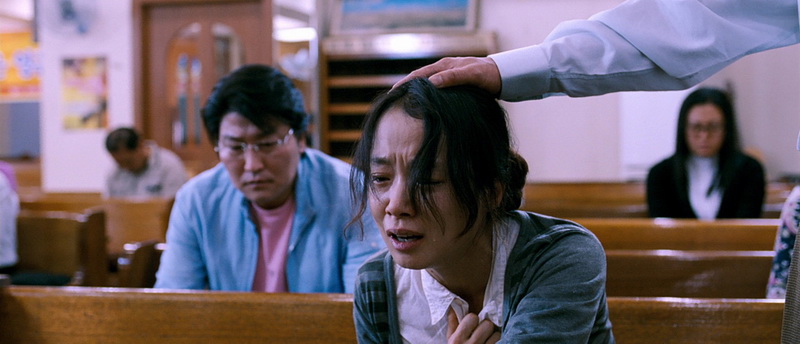
Secret Sunshine, adopted from Yi Chong-jun's ultra-bleak story, has at its center Sin-ae (Jeon Do-yeon), a former piano teacher, who has relocated from Seoul to the small city of Miryang (the literal meaning of the name's Chinese characters is "secret sunshine," or more logically interpreted, "dense sunlight") with a young son after the sudden death of her husband. She assumes a rather haughty attitude toward the locals, including a seemingly clueless and very bourgeois Jong-chan (Song Kang-ho), who becomes instantly smitten with her. When her son is kidnapped and later found murdered, Sin-ae's life abruptly unravels. Caught between directionless rage and abyssal depths of sorrow, she embraces the evangelical Christian faith, previously an object of mild condescension. Yet when she visits the kidnapper-murderer of her son in prison, to declare that she has forgiven him, Sin-ae's world collapses again along with her newfound faith.
There is no need for you to watch this movie if you are expecting some kind of exotic Buddhist or Confucian insights into the human condition (think Kim Ki-duk's more-than-a-little risible Spring, Summer, Fall, Winter... And Spring [2003]). It is true that Secret Sunshine operates on many levels. Some will no doubt consider it as a horror story regarding how certain forms of Christian fanaticism make a mockery out of salvation and forgiveness. Conversely, it works too as an ultimately pro-Christian narrative that, like Wise Blood (1979) and Carl Dreyer's Ordet (1955), features a protagonist who starts from doubt or even denial of God but is eventually allowed to find His love in unexpected ways. Its unflinching exploration of raw emotion, sometimes rapturous and at other times bottomlessly despairing, is carefully balanced by the steadfast observations of the minutiae of everyday life. Director and screenwriter Lee's hands are so assured that the viewers (and more than some critics) tend to miss out just how delicately yet consciously he orchestrates his characters and narrative. His camera, in collaboration with DP Jo Yong-gyu (Crying Fist, The Uninvited) and Lighting Director Joo In-sik (Like A Virgin, Spider Forest), effortlessly assumes the position of a fly-on-the-wall or a surveyor of the bright sunlight, as it mercilessly illuminates the hidden motives and psychological turmoils of the characters.
Lee Chang-dong constructs a cine-scape imbued with an urgent sense of emotional and physical authenticity, as riveting as any created by Ingmar Bergman but also as solidly grounded in mundane reality as any neo-realist masterwork, and then populates it with seemingly dull or almost neurotic yet extraordinarily life-like characters. He carefully reins in the tendency toward the techno-centric display of skills in Jeon Do-yeon's performance: she fully matches the restraint of his direction by presenting a vulnerable yet articulate performance, which never for a moment begs the viewers to sympathize with the almost embarrassingly vainglorious Sin-ae. Song Kang-ho is perhaps given an even more difficult role to play, a catcher against whom Jeon can pitch her strongest, most virtuoso balls, and he is more than up to the task. Like Jeon, Song refuses to turn his perhaps irritatingly prosaic Jong-chan into a supercilious caricature of Korean machismo, and does not once resort to a humorous shtick or a funny turn of a phrase to win the viewer's approval (Anyone who has followed Song's career since No. 3 would know that he is a master of such crowd-pleasing tactics). Their superb performances are sustained by those of the supporting players, a mixture of veterans and amateurs, including a thoroughly heartbreaking turn by non-actress Song Mi-rim, who plays the kidnapper's abused daughter aspiring to be a hair stylist.
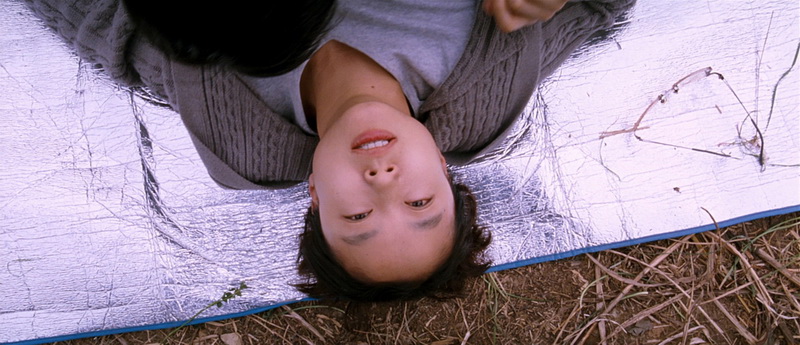
Despite what I have stated above about the multiple possibilities of interpretation, ultimately, I do not believe director Lee's stance is agnostic: the almost nonchalantly quotidian yet devastatingly moving final sequence-- in which Jong-chan displays his true love for Sin-ae by literally holding a mirror to her-- testifies to the message of hope he holds out for Sin-ae (and us), as if a candle that refuses to be blown off even in the midst of gushing black wind. With the minimum of trendy existential angst or self-righteous anti-religious rhetoric, Secret Sunshine allows viewers like myself to share that hope, that there are indeed mysterious ways in our lives for our failings to connect to greater understanding, love and perhaps even salvation.
Blu Ray Presentation: Criterion Collection. NTSC. Region A. Release Date: August 23, 2011. Suggested retail price: $39.95. Video: Anamorphic Widescreen 2.35:1. Audio: Korean DTS-HD Master Audio 5.1. Subtitles: English. Supplement: New interviews with Director Lee Chang-dong, "On the Set of 'Secret Sunshine'" featuring interviews with actors Jeon Do-yeon and Song Kang-ho, U.S. Theatrical Trailer, An Essay by Dennis Lim, "Cinema of Lucidity."
There have been some interesting debates among the Korean cinema fans regarding what would be the first Korean film to be released through the Criterion Collection, the most renowned boutique label (God I hate the sound of that word!) in North America for the DVD (and now Blu Ray) release of past and present cinematic masterworks. The candidates ranged from Park Chan-wook's "forthcoming" piece to Why Has Bodhi-Dharma Left for the East? Secret Sunshine is certainly one of the least eccentric and most deserving choices one could have thought of. No problem there, although I am still hopeful that much more controversial yet important works of Korean cinema, deeply steeped in pulp-ish genre traditions, such as Sorum (2001) or Die Bad (2000) would someday receive the Criterion treatment. If The Anti-Christ, Fat Girl or The Curious Case of Benjamin Button deserves it why not those?
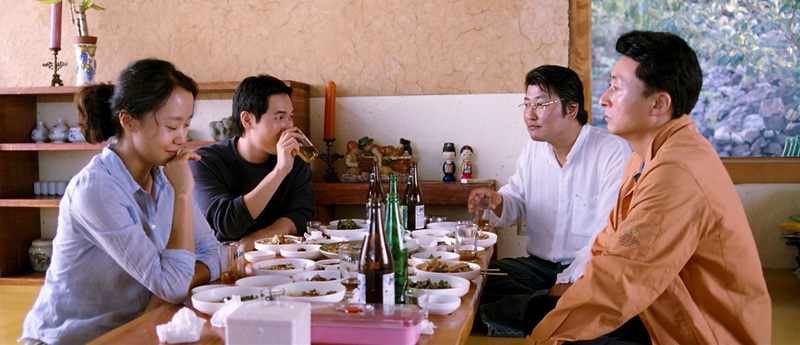
Visually, the Criterion Blu Ray of Secret Sunshine accurately reproduces the theatrical experience I have had in South Korea. As per the quality of usual Criterion presentation, there are no transfer or artifact issues to speak of. The opening chapters show uncommonly harsh, bright lights but they don't seem to come from the gamma-contrast level problems that used to plague Korean transfers, and appear to be rooted in the lighting in the original elements. The color palette is somewhat cold compared to Oasis and Poetry but the unassuming glimpses of nature in the background are captured beautifully: skin tones, texture of wood furniture and concrete roads and other details come off very well. The HD-DTS five-channel audio is likewise not flashy but robust, the rolling, naturalistic tone of the Korean dialogue well served. The English subtitles are supposedly improved over the Korean DVD version but I couldn't tell any significant differences.
The extras are somewhat disappointing considering the extensive and academically superior standard set by a Criterion release. Moving Image Source editor Dennis Lim's essay is an excellent introduction to Lee Chang-dong and Secret Sunshine, thankfully not forgetting to point out how "mainstream" its so-called "Christian" subject is for South Koreans. I would only disagree with one assumption he makes, that Lee's perspective is that of an "outsider." Lee may not be an evangelical born-again but he is clearly interested in the inner workings of Christian churches, and has actively sought cooperation with local pastors in filming prayer and revival meeting sequences set in Miryang. Director Lee interviewed is as usual thoughtful and articulate, if a bit reticent about delving deeply into the themes and ideas expressed in this film. The "making-of" docu is most likely a carry-over from a Region 3 release, but it is always fascinating to listen to Jeon and Song, two of the not only most talented and versatile but also industry-savviest performers in South Korea. Finally, I find the cover art of Jeon Do-yeon in her most agitated outlook not very attractive but many seem to be instantly drawn to it.
Although I wish the presentation was a bit more elaborate (we could have used maybe an audio commentary-- or is the format becoming passé), Criterion Collection showcases one of the best films of last decade from Korea in their customary beautiful and respectful package. Now that this Secret Sunshine Blu Ray has been rumored to be selling like hotcakes at a church bazaar, we hope the company would dip deeper into the pool of Korean cinema to find more worthy masterpieces in the near future.
*Review copy courtesy of Criterion Collection

I Saw Pointless Violence: I SAW THE DEVIL [Blu Ray]
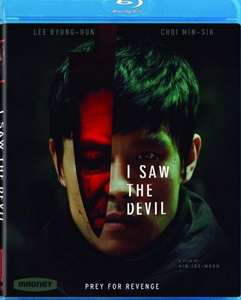 A Peppermint & Company/SIZ Entertainment Produciton. Distributed by Softbank Ventures Korea, Showbox Mediaplex and FINECUT. South Korea. 2 hour 23 minutes (International Version). Executive Producers: Greg Moon, Jeong Hun You, Suh Young-joo, Moon Jae-sik, Cheong Kee-young, Kang Yeong-shin, Kim Kil-soo, Bryan Song, Il Hyung-cho, Kim Byung-ki. Producers: Kim Hyun-woo, Jo Seong-won. Screenplay: Park Hoon-jeong. Cinematography: Lee Mo-gae. Lighting: O Seung-cheol. Production Design: O Hwa-seong. Special Effects Makeup: Kwak Tae-yong, Hwang Hyo-gyun (CELL). Special Visual Effects: Jeong Do-an, Lee Hee-gyung (DEMOLITION). Director: Kim Jee-woon. CAST: Lee Byung-heon (Soo-hyun), Choi Min-sik (Kyung-cheol), Cheon Ho-jin (Chief O), Kim Yoon-seo (Se-yeon), Kim In-seo (Se-joo), Jeon Kuk-hwan (Chief Jang).
Well, there we go, in four words, how I feel about this mega-controversial opus from the talented Kim Jee-woon (The Good, the Bad, the Weird) that for once fits the equally controversial label of "Extreme Asian Cinema" to a T. (Ironical that Tartan America was unable to pick it up for North American distribution) It is indeed such an obviously flag-waving example of the "ultra-violent Asian horror-thriller that Hollywood is too chicken to make" that I might have considered the whole movie a marketing gimmick for North America, had it not been directed by Kim with not only his trademark technical sophistication and visual elegance but also genuine commitment to its abattoir aesthetics. Unfortunately, Kim's sincerity, instead of redeeming the picture from its moral confusion and ugly characterization, serves to drag it back into the swamp, bubbling with gaseous emanations of half-digested ideas, occasionally bursting into flames with outrageous Grand Guignol set-pieces, certainly attention-grabbing but leaving little but the whiff of misguided enthusiasm in their wakes.
I Saw the Devil is certainly neither timid nor self-mocking, as it pushes all the right buttons for gore-hounds, serial-killer mavens and even fans of hyper-violent action film (think of an old-style Hong Kong actioner in which a secret agent played by Chow Yun Fat is going after a serial killer played by Anthony Wong in his most unhinged, An Untold Story-type mode). But it ultimately leaves a hollow feeling, even compared to some gruesome recent films already saddled with the make-you-puke-in-the-theater-isle notoriety-- Dream Home (2010), Audition (1999) or Embodiment of Evil (2008). Kim Jee-woon has little to say through this motion picture, other than his apparent desire to prove that he has the technical command over all existing genres regardless of the sensibilities or tastes required of them and that among these genres is a torture porn/psycho thriller, reduced to its bone-and-gristle armature.
Neither Lee Byung-heon (A Bittersweet Life), as Soo-hyun, the mad-as-hell government agent whose girlfriend was raped, killed and dismembered by a psycho killer, nor Choi Min-sik (Old Boy), as the hideously crass psycho killer Kyung-cheol, can overcome limitations of the characters they play. Director Kim obviously wanted to demonstrate the purposelessness of revenge on the part of Soo-hyun, as well as the meaninglessness of Kyung-cheol's action: but the end effect, at least on my part, is irritation rather than fear or even revulsion, much less insights into the darkness of a human soul. Choi Min-sik is a powerful actor but he is defeated by the inner vacuity of the character he plays. When he is cutting up a young woman and mumbling some inane dialogue in between puffs of smoke, he looks like an irate, overworked butcher having to deal with a rack of particularly tough meat. Lee Byung-heon, on the other hand, gets to competently essay shell-shocked torpor and consuming anger but he is also brought down by the character of Soo-hyun, who is apparently willing to put perfectly innocent bystanders, including his betrothed-victim's own family, in the paths of rape and death just so that he could play the role of a beleaguered lover. In other words, Soo-hyun is just as "crazy" and as much of a public menace as the psycho killer he pursues, yet Kim Jee-woon directs Lee for the most part as if he is a vigilante DC comics hero.
I hope there aren't any critics or reviewers trying to read some subtexts involving the contemporary Korean society into I Saw the Devil: you might as well try to decode the anal fixation among the characters in Human Centipede. I won't go into the film's too-numerous-to-be-coincidental "similarities" to Park Chan-wook's Revenge trilogy, pointed out by more than a few Korean critics. I will simply suggest that Park's movies have the requisite moral weights that adds acceleration to the cinematic wrecking ball smashing into the viewer's bone-globes: I Saw the Devil, in comparison, is like an impressively magnificent-looking wrecking ball that only produces a big noise like a gong, shaking window-panes and toppling glasses. I don't deny that that's something, too, for sure.
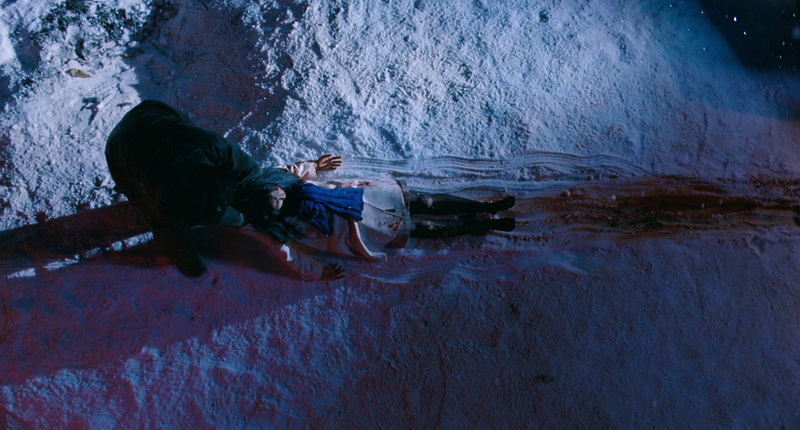
I think the strongest merit that I Saw the Devil can claim for itself, and the genuinely "subversive" element about its "extreme" outlook, is Kim's propensity for (or perhaps his constitutional inability to avoid) pursuit of visual beauty in the scenes meant to provoke terror and revulsion. The first victim, Joo-yeon, for instance, is shown in a strikingly beautiful, clandestinely (perhaps not so clandestinely) tragi-erotic, bird's-eye-view shot, a nude bathed in blood and covered in opaque plastic, just before Kyung-cheol chops her arm off. In another scene, Kyung-cheol counter-attacks a pair of robbers disguised as a taxi driver and a customer, and his savage stabbings produce small geysers of blood, seemingly coordinated like a fountainhead rhythmically shooting off colored water from its spouts while the camera spins like a top. It is a dazzling scene, again despite its utter purposelessness (other than showing off how much of a bad-ass Kyung-cheol is).
However, Kim does not have the conviction of his strengths: instead of deploying his considerable skills in forcing the viewers to confront the moral repugnance as well as the alluring beauty of the murderous and sexual violence-- as in the best examples of Italian giallos-- he reverts back to the slickly choreographed, choppily edited "action" formulas reminiscent of brainless Hollywood blockbusters or boring family melodramas that serve no function other than putting more sympathetic characters in the harm's way. Soo-hyun never really struggles with the moral implications of his own crazy "revenge" scheme: Kyung-cheol's brain seems to have no compartment responsible for self-reflection, only one for super-human street smarts. The ending, when it finally arrives, elicits the ultimate response of "so what?", neither poignant nor genuinely disturbing, relying on Lee Byung-heon's trademark tearful emoting to paper over its blas? quality.
No doubt many sensible people will take I Saw the Devil's combination of the high-caliber film-making know-how, its "unflinching" descriptions of abuse, rape and slaughter (not to mention drug-induced diarrhea: don't ask) and its spiritual vacuity as original or at least intriguing, if not altogether brilliant and courageous. I am sorry I cannot join the bandwagon. The final sentiment that I was left with as credits roll up on the screen was, mixed with small bits of grudging admiration, annoyance: I truly wish it was something else.
Blu Ray Presentation: Magnolia Home Entertainment. NTSC. Region A. Release Date: May 11, 2011. Suggested retail price: $29.98. Video: Anamorphic Widescreen 1.85:1. Audio: English DTS-HD Master Audio 5.1, Korean DTS-HD Master Audio 5.1. Subtitles: English, Spanish. Supplement: Deleted Scenes, Raw and Rough (Behind the Scenes Documentary), Trailer.
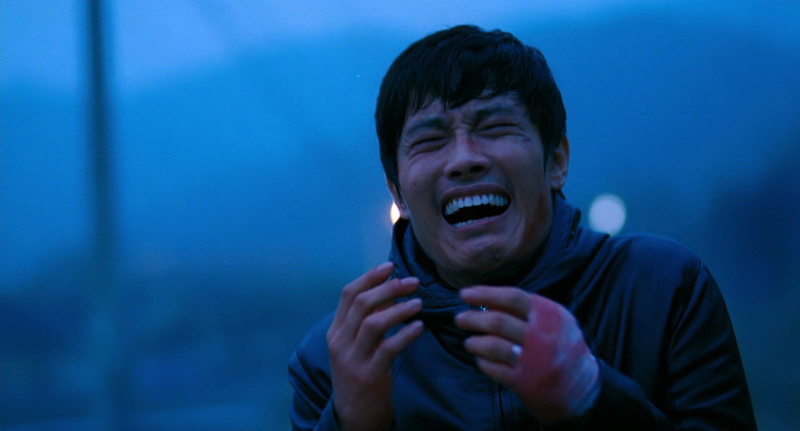
Magnolia's Blu Ray video transfer is beautifully done, superior to their better-than-average Haeundae/Tidal Wave presentation. For your information, this is an international cut of the film restoring some voluntarily censored materials-- mostly additional scenes of gore and realistic wounds and such-- from the Korean theatrical print. I am not sure at this point whether Korean DVDs and Blu Rays also contain this uncut version.
A Kim Jee-woon film would be nothing without glossy, elegant visuals and DP Lee Mo-gae, a frequent collaborator for the director, flexes his muscles to create a wonderful texture that easily overcomes tough photographic conditions such as a white landscape dominated by falling snow-flakes, or Soo-hyun scaling the fortifications of his target's house in one take like auditioning for Spider-man. Neither the excessive contrast/boosted clarity nor digital artifacts raise their ugly heads, in contrast to the ugly shenanigans in the film itself. The color timing prefers cobalt blue and crimson red (blood) and as far as I can determine it is a reasonably accurate reproduction of the theatrical print I had seen last year. It looks fairly stunning on my pre-LED Samsung HD TV.
The DTS-HD soundtrack also sounds fine, although like 13 Assassins the dialogue channel could have been somewhat stronger. I did not even sample English dubbing: for all I know it's not too bad, but if you know anything about Lee Byung-heon, you know that dubbing his voice robs him about 40% of his acting capacity. Give it a pass.
The supplements are deleted scenes and a fairly elaborate making-of docu. Not too bountiful, but the days of 3-disc special edition DVDs with the supplement discs jam-packed with production notes, galleries with hundreds of pictures and whatnot are apparently over. Deleted scenes (clocking at about 25 minutes) involve more character details regarding Soo-hyun, Kyung-cheol and other personages. Personally I found the interaction between veterans Cheon Ho-jin (as Soo-hyun's superior) and Jeon Kuk-hwan (as Joo-yeon's father) most interesting. Raw and Rough, which extends to appx. 27 minutes, is mostly concerned with the film's action choreography, supervised by Jeong Doo-hong. It is fascinating to see the different styles of Choi Min-sik and Lee Byung-heon using their bodies to project menace and rage, and what kind of utterly primitive technology was used to illustrate an impressive car chase sequence near the climax. Some good ol' Korean stuff apparently never change.
While I Saw the Devil in my opinion is a huge disappointment from the obviously talented Kim Jee-woon, working with two bona fide Korean stars, Magnolia's Blu Ray presentation does justice to the film's high-class audio-visual pedigree.
* Blu Ray for review courtesy of Magnolia Home Entertainment

Your Pooch is in My Soup (with Lots of Green Onions): BARKING DOGS NEVER BITE [DVD]
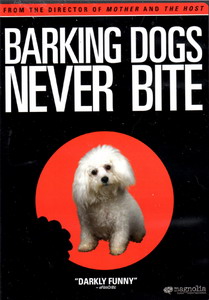 A Uno Film/Sidus FNH Production, 2000. Distributed domestically by Cinema Service & CJ Entertainment. South Korea. 1 hour 48 minutes. Director: Bong Joon-ho. Screenplay by Song Ji-ho, Sohn Tae-woong, Bong Joon-ho. Cinematography: Jo Yong-gyu. Lighting: Park Jong-hwan. Production Design: Lee Young, Lee Jin-young. Music: Jo Seong-woo. CAST: Lee Sung-jae (Yoon-joo), Bae Doo-na (Hyun-nam), Kim Ho-jung (Eun-sil), Byun Hee-bong (The Creepy Janitor), Kim Roe-ha (The Drifter), Go Soo-hee (Jang-mi).
No need to worry, Bong Joon-ho's twisted but ultimately lovely debut feature is not interested in pushing the dog-meat-as-traditional-food agenda. If anything, director Bong is squarely on the side of dog-lovers, and shows with great subtlety and sensitivity that South Koreans, circa 2000, could be just as attached to their pets as any North American suburbanite. True, dogs do encounter serious peril as well as untimely death in this film (not during production, of course), so those extremely sensitive to this issue might want to reconsider your rental or purchase. On the other hand, it might turn out to be a refreshing experience for those curmudgeons who have always found an incessantly yapping Chihuahua about as attractive as a tapeworm (I know many of you are in the States, don't deny it). In any case, dogs only play the roles of catalyst in the movie, which is, among other things, a terrific absurdist comedy and a powerfully on-target satire of the social hypocrisies of modern Korean life.
Lee Sung-jae (Natalie, Public Enemy) plays Yoon-ju, a Ph. D-ed lecturer in an anonymous university who must raise money to bribe his Dean so that he could be appointed an FTE (full time employment) professor. Emasculated and feeling guilty toward his hard-working wife Eun-sil (Kim Ho-jung, Nabi, Woman is the Future of Man), he lets his frustrations out on a neighbor's dog with particularly annoying barks. One thing leads to another and he ends up becoming a serial murderer of pet dogs in the apartment complex, partly willingly and partly due to accumulation of coincidences. In the course of these events, he becomes the unseen nemesis of perennially befuddled Hyun-nam (Bae Doo-na, Air Doll, The Host), a young clerk working for the apartment office, whose favorite daydream is to break out in the TV news as a "brave citizen," like the young bank teller who caught a robber bare-handed.
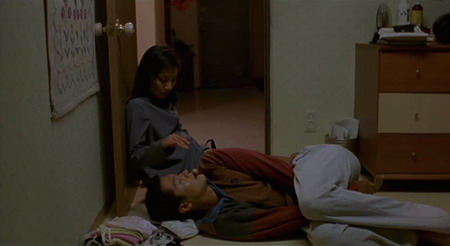 Barking Dogs Never Bite combines almost embarrassingly honest depictions of certain aspects of Korean life- corrupted behaviors of the intellectual elite, difficulties of capable women stuck in a patriarchal hierarchy, the media's selective portrayal of "reality"- with the kind of localized eccentricities that are uproariously funny and at the same time a bit disconcerting. Bong and his production team, including DP Jo Yong-gyu and Lighting Supervisor Park Jong-hwan, give the proceedings a slightly cartoonish ambience of hyper-reality with just a hint of bug-eyed craziness mixed in, anticipating the tonalities of late-2000s comic artists like Gangfull, yet the overall impression of the film is leisurely and languid. The (now-famous) yellow color scheme, ingenuously deployed throughout the movie- most strikingly in the raincoats worn by a few minor characters-, exudes comfort and warmth, rather than serving as some dazzling display of Storaro-like chroma-thematics.
Watching the movie again after many years, I was also struck anew by how much Bong had already been firmly in command of his (superb) cast in this debut feature, allowing them to sculpt fully rounded characters with the aid of highly sophisticated but subdued cinematic techniques (receding backgrounds, skewed camera angles, etc.). Bae Doo-na is at her most ridiculously charming here but there are scenes in which her saucer-eyed, plaintive stare appears both chuckle-inducingly goofy and heartbreakingly sad. Lee Sung-jae gives what is likely his best-ever performance as a seeming villain of the piece, who, under Bong's masterful direction, turns into a much more sympathetic figure, devoid of macho whining that passes for characterization in 95% of the Korean roles in his socio-economic position. Kim Ho-jung as the very pregnant, hardworking wife is also given her due: her first scene in the movie, in which she places a piece of walnut on her sleeping husband's lips, is creepy, funny and somehow touching all at once. And of course, who could forget Mr. Janitor played by TV veteran Byun Hee-bong (the paterfamilias of The Host) and his hilariously lurid telling of the urban myth starring "Mr. Boiler Kim?" The inimitable tone of this sequence is strictly Bong Joon-ho's, not shared by any other Korean (or for that matter, non-Korean) filmmaker that I know.
The film, made eleven years ago, has some rough patches and is not nearly as tightly constructed as Bong's later works, but as a debut feature it is quite accomplished, and carries with it the fully formed Bong Joon-ho sensibility: tough-minded humanism refracted through hard-edged, sui generis sense of humor and super-intelligent appreciation of the abject absurdities of the ordinary Korean lives.
DVD Presentation: Magnolia Home Entertainment. NTSC. Region 1. Release Date: July 20, 2010. Suggested retail price: $19.98. Video: Anamorphic Widescreen 1.85:1. Audio: Korean Dolby Digital 5.0, Korean Dolby Digital 2.0. Subtitles: English, Spanish. Supplement: Interview with Bae Doo-na, Storyboard and Film Comparisons, Highlight Montage, International Trailer.
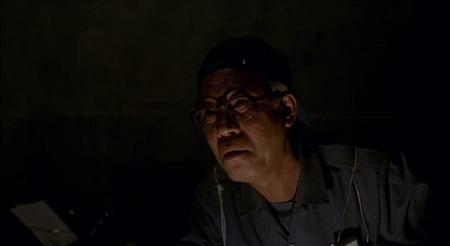 Barking Dogs Never Bite has been released by Magnolia Home Entertainment into Region 1 DVD market in tandem with their Mother Blu Ray, one of the pleasant surprises of 2010. Having seen the movie in theater but not via the presently out-of-print Region 3 version, I cannot tell whether the transfer is an improvement, but it does have the look of early 2000s Korean DVD transfer, with somewhat excessive contrast which tends to make very dark scenes rather murky. On the other hand, the transfer is clear enough so that one can properly appreciate the movie's distinctive color scheme. It appears to be progressive but bitrate is not overwhelmingly high. Audio is bereft of DTS or other technological boosting but serves its purpose perfectly, delivering dialogues and infectious jazz scores with clarity.
Special features, presumably imported directly from the old Region 3 DVD, for some reason do not include the Bong Joon-ho commentary but does retain a latter-date interview of Bae Doo-na by director Bong, of some potential interest to her fans: Bae started out as a model with ambi-sexual appeal and the interview hints at the level of anxiety she had suffered in playing a character so plain, unkempt and more than a little goofy. "Highlight Montage" is one of those totally pointless EPK modules that have long fallen into disuse, and for good reasons: it simply is select passages from the film edited together in the MTV style. It serves absolutely no discernible function except as spoilers for those who haven't seen the film. English subtitles on the interview are of excellent quality: it probably is due to the incredible quality control Bong exercises over the secondary marketing of his works, but Magnolia can take the credit anyway.
We are very pleased with this release of Barking Dogs Never Bite: we hope Magnolia gets more heavily involved in introducing unknown and unjustly ignored Korean films from the previous decade to the Region 1 market. There are some gems out there that can run circles around the so-called blockbusters churned out today: Sidus FNH's older titles, mostly produced by Tcha Sung-jai as was Barking Dogs (Phantom the Submarine, My Beautiful Girl Mari, One Fine Spring Day, Once Upon a Time in High School, The Big Swindle, to name just a few), would be a good place to start.
* DVD for review courtesy of Magnolia Home Entertainment
Killing Love: MOTHER [Blu Ray]
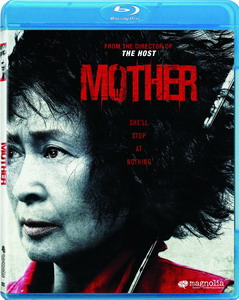 A Barunson Pictures Production. Distributed by CJ Entertainment, 2009. South Korea. 2 hour 8 minutes. Director: Bong Joon-ho. Screenplay: Bong Joon-ho, Park Eun-kyo. Cinematography: Alex Hong [Hong Gyeong-pyo]. Lighting: Choe Cheol-soo, Park Dong-soon. Music: Lee Byung-woo. Editor: Moon Se-gyoung. Production Design: Ryoo Seong-hie. Special Effects: Jung Do-an, Ryoo Young-il, Kwak Tae-yong, Hwang Hyo-gyun. Makeup: Choe Se-yeon, Hwang Hyeon-gyu. Sound: Choi Tae-young. Producer: Moon Yang-kwon. CAST: Kim Hye-ja (Hye-ja), Won Bin (Do-joon), Jin Gu (Jin-tae), Yoon Je-moon (Je-moon, the senior detective), Jeon Mi-sun (Mi-sun, the photographer), Song Sae-byeok (Hong-jo, the junior detective), Moon Hee-ra (Ah-jung), Cheon Woo-hee (Mina), Jo Kyung-sook (Mina's Mom).
Do-joon (Won Bin) is a mentally challenged but exceptionally handsome young man, treated as a village idiot and dragged around by a small-time thug and fishing bait merchant Jin-tae (Jin Gu). Hye-ja (Kim Hye-ja), Do-joon's pharmacist mother, is utterly devoted to him, perennially cleaning up the messes left by the two in the wake of pranks and misdemeanors. One day, to everyone's astonishment, Do-joon is arrested for the vicious murder of a high school girl Ah-jung (Moon Hee-ra), rumored to have been prostituting herself for food. The case against his son seems rock-hard, but Hye-ja launches her own awkward investigation, hoping to nab the real culprit. However, everyone in the town seems to harbor some dark secret, threatened to be uncovered by her sleuthing. Hye-ja herself cannot escape the tentacles of awful corruption reaching for her soul from under the rocks she had overturned.
In this elegantly venomous film noir, director Bong Joon-ho takes an almost humorous premise of a hapless parent taking on the job of amateur sleuthing for her son and turns it into a pitch-black story of moral defeat in the face of overwhelming social evil and blind devotion to family love. Bong, as David Lynch did in Blue Velvet, captures festering corruption and inhumanity that underlie the life as usual in a seemingly sleepy regional town, where everyone is ensnared into a hellish network of exploitative food-chain relationship. He spares no authority figure: pompous, parasitic lawyers and academics, obtuse and indifferent police, disgustingly hypocritical middle-aged cads and weasel-like, drooling teenagers, all ultimately converging on Ah-jung like swamp leeches, in the sexual exploitation of whom even her demented, foul-mouthed grandmother is complicit. And yet Bong does not let us get off the hook by handing down hissable villains to whom we can feel dismissively superior. Instead he makes sure that our responses to the characters waver uncomfortably between sympathy and disgust, identification and repulsion.
Visually, eschewing warm, yellow-dominated hues of Bong's previous films, DP Alex Hong (Taeguki, The Foul King) emphasizes cold, sharp blues and austere compositions of natural landscape that at times threatens to dwarf the characters. With the help of Hong and the production designer Ryu Seong-hie (Old Boy, I'm Cyborg But That's OK), Bong communicates much information and insight through pure images, in such scenes as Hye-ja noticing a young tree jutting up forlornly during her trip back from the police station, or a one-page-a-day calendar dancing and flipping its sheets in a frantic fast-forward into the future as it is licked and consumed by flame. Long-time collaborator Lee Byung-woo contributes another masterful score, combining superficially cheerful yet deeply melancholy Latin dance tunes with bizarrely charming, Nino Rota-like circus music.
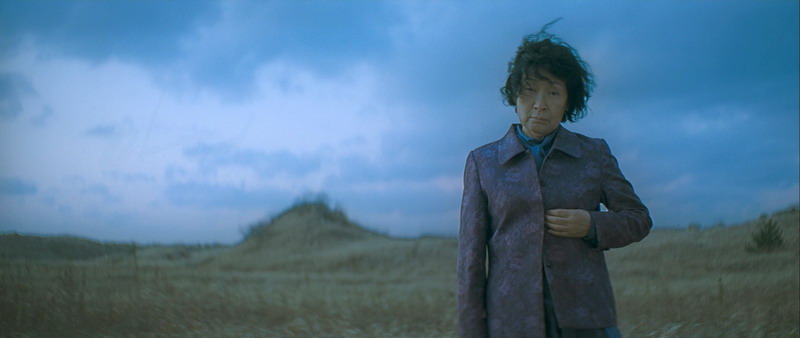
While Mother is a great showcase for Bong Joon-ho's seemingly bottomless directorial talent, it would not have retained half its power if not for Kim Hye-ja's marvelous performance in the title role. She is absolutely riveting from the frame one, when Hye-ja seemingly wanders out of nowhere and begins to dance, her face a horrid mask pregnant with mysterious knowledge and emotion. Savoring Kim's performance in this film is the Korean equivalent of seeing Lucille Ball cast as Queen Eleanor in Lion in Winter and blasting Katherine Hepburn out of water. Won Bin brings both tenderness and an unexpected level of chilling primness to his role. Yoon Je-moon as the sympathetic local cop, newcomer Song Sae-byeok as his funny-scary, martial-arts-obsessed underling, and Jin Gu as the alternately friendly and thuggish petty gangster are all memorable in their supporting roles.
Make no mistake, Mother is not a feel-good commercial hit of the summer Hollywood variety. It is the kind of movie that leaves you spent and even devastated. The absolutely frightening yet unmistakably sad "crazy dance" that ends the film, taken with a violently shaking handheld camera, is like a primal scream from the depth of human heart, excavated by a filmmaker that dares to dig deeper into the subterranean layers of the Korean psyche than almost any other filmmaker at work today. It will haunt you long after the movie is over.
Blu Ray Presentation: Magnolia Home Entertainment. NTSC. Region Free. Release Date: July 20, 2010. Suggested Retail Price: $29.98 Video: Anamorphic Widescreen 2.35:1, 1080p High Definition. Audio: Korean, 5.1 DTS-HD Master. Subtitles: English, Spanish. Supplements: Making-of documentary, a look at actress Kim Hye-ja, featurettes on production design, supporting actors, cinematography and music score.
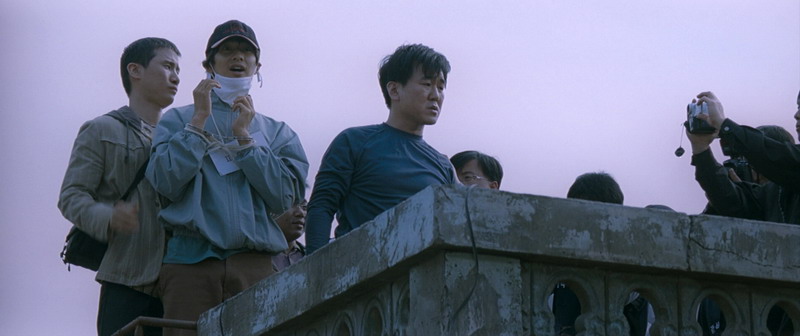
Mother has turned out to be one of the most critically lauded Korean films to be imported into North America in recent memory, making it to Wall Street Journal and Film Comment's year's best lists for 2010. On the home video market, Magnolia follows their superb presentation of The Host up with another winner directed by Bong Joon-ho. Mother is a visually striking feature but I should warn that this Blu Ray is rather subdued. I suspect it is a direct carry-over from the CJ Entertainment's hi-def transfer, with the expected high contrast as well as somewhat flat black levels. [According to DVDBeaver, the CJ version has warmer and stronger colors, so I may be wrong about it being a direct carry-over] The "pop" an American consumer is likely to expect from a demo-level Blu Ray is largely missing, even compared to Magnolia's own Tidal Wave. I think the darker image and a greater level of color saturation would not have been a bad thing, considering that the theatrical prints I have seen were a bit more colorful than what's shown here. DTS-HD sound is much more impressive, with robust directionality and clear separation of channels among music, dialogue and sound effects. The dialogue sounds very crisp and the distinctive music comes out beautifully. By the way, unlike Tidal Wave, the soundtrack choices do not include an English dub track, which is as it should be since any English dubbing of Kim Hye-ja's vocal performance would have completely ruined the film.
The supplements are also seemingly carried over from Korean CJ Blu Ray. One wonders with the virtual death of the DVD market in Korea, this type of special features will ever be available at all from now on. Anyway, as is usual with the special features of a Bong Joon-ho film, the director is on hand to provide introduction for nearly all aspects of the production, from Lee Byung-woo's music score to Alex Hong's cinematography and casting of various roles. Each category receives a separate treatment while an impressively exhaustive (clocking at 1 hour and 30 minutes) making-of docu covers all three phases of production. The best featurette is one entitled "A Look at Actress Kim Hye-ja," which pivots around director Bong's pursuit of the veteran TV actress Kim for the role of the mother. It provides the necessary context for understanding the crucial casting of Kim Hye-ja for the title role. Let me drop a line here that one constituency who might be potentially disappointed are fans of the supernaturally pretty Won Bin, whose relative absence is notable, given that, commercially speaking in the East Asian market, Mother was seen as a transition vehicle for Won Bin from a specialist in "my cute little brother" roles to a versatile, adult actor.
Even though Magnolia's Mother Blu Ray might not strike a casual viewer as an eye-popping improvement over the DVD, it is still a top-of-the-line production that does justice to one of the best Korean films to be released stateside in the last half-decade.
Unhealed scars of Gwangju from a local perspective: SOONJI a.k.a. MAY STORY [DVD]
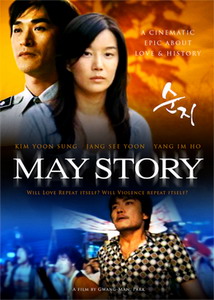 A Cineworks Production, 2009. South Korea, 1 hour 29 minutes. Written and Directed by Park Gwang Mann. Cast: Jang Se-yoon (Soonji), Yang Im-ho (Officer Jeong), Kim Yoon-sung (Jjagu), Choi Dae-sung (Ddaksae), Lee Seol-gu (Paratrooper Leader).
I am genuinely surprised to find this local (Gwangju) indie production lurking in the North American DVD market. It is even available through Netflix! As far as I know Soonji never played theatrically in Seoul outside the festival circuit, nor has it been released on Region 3 DVD.
Soonji (Jang Se-yoon), a pretty woman in late twenties, runs a live chicken stew restaurant all by herself in an outskirt area of Gwangju. As the film opens, she seems to be unreasonably unresponsive to Officer Jeong (Yang Im-ho)'s courting gestures, while casually taking advantage of his kindness. As the May 18, the day her father allegedly went missing, encroaches on the calendar, she reveals traces of deep psychological disturbance: finding herself in a nightmare where she is imprisoned in a chicken coop, deliberately spilling food on her foul-mouthed former classmate, and so on. One evening, Soonji is threatened with potential rape and worse by a trio of ne'er-do-wells headed by the mustachioed thug Jjagu (Kim Yoon-sang). Inexplicably, she not only feeds them a freshly cooked chicken stew dinner, but also helps Jjagu steal some real guns and ammo from the police station where Jeong works. The fact that Jjagu is behaving as if his clock stopped in 1980, mumbling something about joining the "citizen's army" against the government, provides a clue to what is really going on, at least for the Korean viewers who cannot miss the meaning of May 18, 1980. Whether it works the same way for non-Korean viewers will depend on their level of tolerance for obscurantist art-house touches as well as the gimmick of blurring the distance between "reality" and "re-creation of reality," which director Park Gwang Mann heavily indulges in toward the latter half of the movie.
The Gwangju Massacre, in which hundreds (up to thousands in some accounts) of the citizens were brutalized and killed by the paratroopers sent down by the military dictator Chun Doo Hwan, finally became the subject of a mainstream commercial film last year (May 18, also to be released on Region 1 DVD in a few weeks), but has haunted the Korean cinema for close to 30 years in a variety of forms, constituting an essential background for understanding such diverse group of works as Jang Seon-woo's A Petal, Lee Chang-dong's Peppermint Candy and even Kim Hyun-seok's Scout.
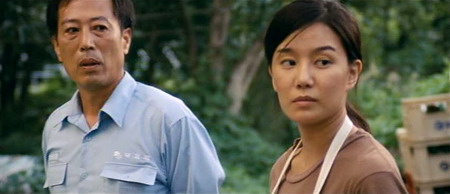 Director Park, instead of depicting the events themselves or telling the stories of those who have experienced the massacre at first hand, decided to construct a love-triangle story around 2007's Gwangju-city-organized ceremony in commemoration of the Massacre, a re-enactment performance, a street demonstration and a shamanistic ritual rolled into one. In the film, however, the historical "reality" of 1980, which the viewers only access through highly symbolic performance art during the ceremony, the "fictional" reality of the movie's characters, and the documentary "reality" of the 2007 ceremony participated by the actors are allowed to overlap with one another, reaching for the violent climax in which key characters must literally re-live the gut-wrenching horror of the May 18th. As a Brechtian device to call attention to the essentially un-narratable nature of the Massacre, this layered approach is at least intriguing. Alas, the actual outcome is likely to induce boredom and confusion rather than shock and understanding on the part of the viewers.
The decision to keep the past histories of Jjagu, Officer Jeong and Soonji obscure might have been intended to keep the viewers in suspense regarding how the love triangle would turn out, but it completely backfires. The romance between Jjagu and Soonji seem wholly contrived, Officer Jeong appears to be blamed as a heavy simply because he is doing his job as a policeman, and by the final reel the whole thing begins to smack of a bad dress rehearsal for a play with a couple of actors going annoyingly, even somewhat comically, berserk-Method. Part of the problem is that Kim Yoon-sang's Jjagu is so underwhelming as a character that one cannot invest any emotion in him. Frankly it is just annoying when he begins to spew forth (stilted) dialogue about defending democracy and then scream and holler, waving a pistol in the air. Is he supposed to represent the ghost of the dead protester at Gwangju? I hope not, since he is nothing more than a cocky macho cipher. The victims of the Massacre deserve better. Jang Se-yoon gives Soonji a lot more dimension, convincingly portraying her gumption, obstinacy and sadness, but her character in the end is reduced to that Korean inkwell-sucker's old cliche, a woman whose body must bear "the unhealed scars of Korean history."
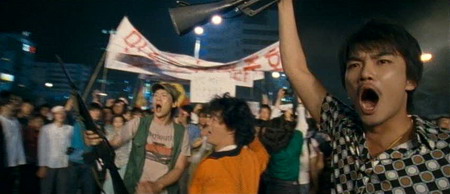 Director Park's intents appear to be honorable, but the movie itself simply does not communicate them in a legible way to the audience, generating a heartburn-like sense of frustration instead of emotional resonance. Still, even though the viewing experience is not altogether satisfactory, Soonji deserves a place in Korean cinematic history as a local production that delves into one of the worst political tragedies in postwar Korean history, along with its impressive documentary-like footage of the 2007 commemoration ceremony.
DVD Presentation:
Vanguard. NTSC. Single Layer. Region 1. Release Date: February 23, 2010. Suggested Retail Price: $19.95. Video: 2.35:1, Audio: Korean Stereo 2.0. Subtitle: English (Not optional). Supplement: Theatrical Trailer.
Vanguard cinema releases Soonji under the title May Story on Region 1 DVD. The 2.35 widescreen video transfer is anamorphically enhanced but merely adequate in quality. The picture is a bit too bright and there are continuous presence of video noise and artifacts throughout the film. Video is also interlaced and becomes unusually aggravating in a few scenes with fast movement. Audio is equally lackluster: I can't even tell if it's in Dolby Digital.
English subtitles are burnt into the print and cannot be removed. They are serviceable with occasional confusions regarding place names, colloquial expressions and such.
To be honest I have no idea what Vanguard was thinking when they picked this up, but given the undeserving indifference to which the movie was subjected in Korea, I am glad that they added it to their roster of North American DVD releases.
War is evil, and Koreans knew that better than you ever did: THE MARINES WHO NEVER RETURNED [DVD]
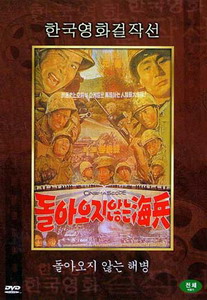 A Daewon Film Production Company Film, 1963. South Korea, 1 hour 49 minutes. Directed by Lee Man-hee. Written by Chang Gook-jin, Yu Han-cheol. Cinematography by Seo Jeong-min. Production Design by Hong seong-chil. Music by Jeon Jeong-geun. Lighting by Chang Ki-ryong. Editor Kim Hee-su. Cast: Jang Dong-hwi (Kang Tae-sik, Squadron Leader), Choe Mu-ryong (Private Choe), Yi Tae-yup (Jeong-ik), Goo Bong-seo (Bong-gu)
The Marines Who Never Returned is a Korean War film made less than ten years after the conclusion of the war. A multiple prize-winner at the 2nd Grand Bell Awards, the movie is considered one of the masterpieces of Lee Man-hee, a major Korean director of '60s, who regrettably passed away in 1977 at the very young age of 44.
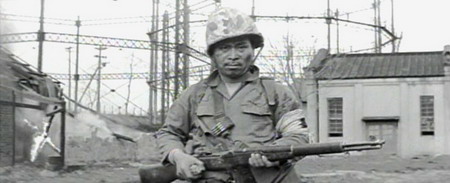
Marines is different from the countless Korean War films I have watched while growing up (Although I am pretty darn sure I saw it at least once on TV). Exquisitely shot in black and white by Seo Jeong-min and the crew, favoring medium- or long shots that frame the soldiers in the wide horizontal space, the movie's visuals do remind me of the rather leisurely-paced Second World War films such as The Longest Day, although it features some sequences that look like they might have seriously endangered the lives of the crew and cast. Apparently real explosives were used to illustrate the shelling of North Korean cannons, and there are several scenes where actors are showered with tons of real dirt and debris, not fake ones made of cork particles and Styrofoam. All military vehicles such as amphibian tanks are, as far as I can see, genuine articles. The battle scenes are classically set up and filmed. There are no disorienting jump cuts, close-ups, hand-held camera: cinematic techniques yet to reach the Korean soil in 1962.
Even though director Lee goes through the motions of making a standard anti-Communist propaganda movie, with such familiar tropes as a war orphan adopted as a mascot, a tracking shot of villagers massacred by North Korean troops, and two soldiers in conflict with one another over split family loyalties, Marines is remarkable in its cynical attitude toward the war. The heroes fight for survival, not for heroism or glory of the fatherland, and death scenes are powerful in their finality and severity. The movie also includes an extended sequence in which the squadron members are treated like bums by the "Yankee princess" prostitutes: the seething resentment South Korean soldiers feel against this discrimination is surprising, considering the extent to which critique of American military in any form was strictly no-no in 1960s and 1970s.
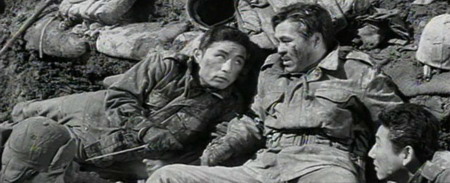
 Later, the squadron leader played by Jang Dong-hwi and his members have a serious exchange in the middle of a battle, which comes very close to branding all forms of war, even a defensive war, as evil. This scene must have skirted acceptable boundaries of the censorship, and considering that even Apocalypse Now was banned from Korea in '80s due to its supposedly antiwar message, I find it remarkable that this sequence was allowed to remain intact. The final battle is set up as a drawn-out, grueling survival course in which patience and perseverance count far more than bravado or even skills with weapons. The squadron members are killed one by one, as they withstand again and again the massive onslaught of Chinese troops. The viewers are made to feel the sheer fatigue and despair of the survivors.
Choe Mu-ryong, the postwar film star Choe Min-su's father, and Lee Dae-yup are good in their respective roles. Choe has the ?lan of a '50s Hollywood star, smoking cigarettes and fixing a madam with a cocky stare. Jang Dong-hwi is gruff, solid and flashes surprisingly warm smiles when least expected. However, the best character in the whole show is without question Goo Bong-seo's Bong-gu (Note: this is the name listed in IMDB, but the film does not mention Goo's character's name at all). Even though his role is obviously intended as a comic relief, Goo's brilliant acting gives it a unique and interesting spin. His character is from an urban, well-to-do family and it is made clear that he joined the marines partly to taste a sense of freedom and adventure, not because he was drafted. He also reveals tough, calculating sides. Bong-gu is completely unfazed when a mate is upset by his jokes: when asked how he feels about first battle, he coolly quips, "As long as I am alive, it is not a bad exercise." (The interesting thing is that he is not saying it to brace himself up¡¦ this is what he really believes in. Is it just me or does Goo Bong-seo gets all the best lines in this movie?) Much of what he does in the movie is indeed funny (I especially liked the historically incorrect "twist" dance number in the base camp, as well as his "Konglish" explanation to the American troops about why they can't enter the brothel), but he also contributes a smashingly effective dramatic performance.
DVD Presentation:
Bitwin. NTSC. Single Layer. Region Free. Video: 2.35:1. Audio: Dolby Digital Mono. Subtitles: Korean, English. Supplement: Theatrical Trailer. Release Date: February 26, 2002.
One of the first non-contemporary Korean films to be released on the DVD format way back in 2002 as a part of the now-sadly-defunct Bitwn Classic Korean Cinema Series, Marines is still in print as of June 2010. The transfer itself is good by the standard of early 2000s, although not anamorphically enhanced. There are inevitable white spots, scratches and blemishes: the dirt is especially noticeable during reel changes, although the intro battle sequence is surprisingly clean. There are also some curious pixelization problems in the deep blacks, thankfully not very often.
 The soundtrack is Dolby Digital Mono, but definitely above the par. Dialogues tend to break apart in high pitch, but music score and sound effects are robust and clear, giving the epic dimensions of the film a workout. In this case, a powerful soundtrack is in fact more important than the correct aspect ratio in terms of its superiority to a VHS edition. The audio, though, has one big boo-boo: the very last five seconds or so of the film is without sound, apparently due to the deterioration in the original elements. I was very disappointed with this: as it stands, the surging male choir in the background is abruptly cut off and unable to bring the emotional final scene to an appropriate conclusion.
English subtitles avoid inappropriate colloquialisms and typos, and are nicely done. A little more sophistication could have helped, since the dialogue is surprisingly literary for a war movie.
The Marines Who Never Returned is dated in many aspects, and arguably it does not push the envelope much in terms of aesthetics as Lee's other smaller-scale films do. Nonetheless, it is a true epic and one of the best films I have seen from the "First Golden Age" of Korean cinema. Strongly recommended, despite its non-anamorphic transfer, while the supply lasts.
Seriously, it's getting really wet over here: TIDAL WAVE/HAEUNDAE [Blu Ray]
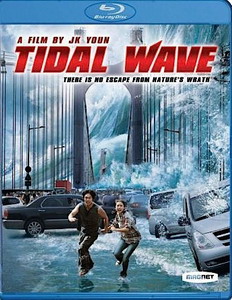 A JK Film/CJ Entertainment Production, 2009. South Korea. 2 hour. Produced and Directed by JK Youn. Screenplay: JK Youn, Kim Hwi. Executive Producer: Katharine Kim. Production Designer: Hwang In-joon, Editor: Shin Min-kyung. Special Visual Effects Supervisors: Hans Uhlig, Jang Sung-ho. Music: Lee Byung-woo. Cinematography: Kim Young-ho. CAST: Park Joong-Hoon, Sul Kyung-gu, Ha Ji-won, Uhm Jung-hwa, Lee Min-ki, Song Jae-ho, Kang Ye-won, Kim In-kwon.
The Korean summer season in 2009 was, box-office-wise, dominated by two films, Take Off and Haeundae, one an underdog-coming-out-on-the-top sports drama and the other a pointedly Hollywood-like, nay, old Hollywood-like natural disaster extravaganza, selling more than 8.5 million and 10 million tickets, respectively. It is not immediately clear whether these two films indicate the evolution of the "copywood" trend that has in fact been going on since late '90s, despite all the superficial self-congratulatory rhetoric about protection of the domestic film industry against foreign encroachment, or instances of Korean filmmakers savvily adapting the Hollywood know-how for the domestic market. The makers of both films would surely want us to think the latter, but even if that was true, it does not unfortunately excuse the sorry quality of Haeundae, which is a stupefying collection of both hoary Hollywood-disaster movie clichés and the most obnoxiously exaggerated Korean melodramatic clichés.
Having said this, it certainly makes sense to me that Haeundae, as turbidly un-original as it is, managed to rake bucket-loads of money from among the Korean viewers, far more so than that Dragon Wars or even King and the Clown did. For most Koreans, for whom the Haeundae beach at the Southernmost of Busan had been the only "beachside resort" in the Euro-American mode available to them for the long stretch of modern Korean history, the idea of it being overrun by a gargantuan tsunami must have a built-in gotta-see-how-wild-it-looks curiosity quotient, combined with perhaps a barely suppressed sense of giddy delight and of anticipation raised, despite their better judgment, by the sheer carny-barker chutzpah of it all. It's the equivalent of a volcano exploding under Niagara Falls and turning all of their water into steam, then the said water raining down on and completely submerging the city of Buffalo underwater. Now North American readers might have some idea of just how far-fetched the premise of Haeundae is. It's precisely the kind of project that Irwin Allen (The Towering Inferno, The Swarm) would have embraced eagerly had he been working in South Korea.
JK Youn or Youn Je-kyun (the auteur behind Sex is Zero, My Boss My Hero and his true piece de resistance, Romantic Assassin) might be considered a surprising choice for a special-effects-ridden blockbuster like Haeundae, but in fact he is exactly the kind of producer-director who would unabashedly take stock of every cliché in Hollywood movies and then "domesticate" them by dressing them up with local flavor, all the while pontificating how patriotic his latest blockbuster is with a straight face. Subtlety in characterization? Artistic intent? Hey, bro, you be lookin' at a wrong flick. And let's be honest, these kinds of commercial strategies still work like gangbusters, especially in the local Korean markets.

I must say, even knowing what I should have expected, I do wish at least some of the characters had been given moderately interesting materials to work with. Sol Kyung-ku (Peppermint Candy, Oasis), despite his De Niro-like reputation overseas, has appeared in more than a few terrible films in his career and here, he is exactly only as good as the material he is given, which is to say, not at all. Ha Ji-won (Phone, Duelist) comes off slightly better but the subtle make-up job on her fails to suppress her incongruously movie-star good looks. Uhm Jung-hwa is more believable, but her histrionics caught up in the flooding elevator is sheer embarrassment. As her fan, I don't want her to suffer this kind of indignity ever again in a Korean motion picture. Park Joong-hoon is charismatic and fun but he is as believable in his role as a cracker-jack seismologist as Sean Connery would be playing a gay ballet choreographer. Kim In-kwon (Once Upon a Time in High School) and Kang Ye-won do their best in drearily predictable supporting roles, the former especially made to preen around like Cheetah to Sol's Tarzan. The veteran Song Jae-ho, not even listed in the English cast roster, essays a real estate developer, the only character with some tenuous connection to the reality outside the disaster-movie clich?s.
Perhaps I should be just thankful that the yang'achi thugs only make brief appearances and the movie was generally cleaned up of doltish "messages (anti-American or anti-Japanese, anti-McDonald, or whatever following the current fashion in Korea)" or bathroom humor. Oh, the special effects? It's OK. The gigantic wall of water endlessly suspended in the air before thrashing down at the hapless onlookers might trigger one's sense of awe for one second or two, depending on how pure-hearted or gullible you are.
Haeundae in the end is a well-calculated commercial project that partakes of undeniably improved filmmaking skills of contemporary Korean cinema industry to present the local viewers with an evening of brainless entertainment. It's plenty irritating, groan-inducing and aggressively boring in patches, but it's no less brainless than 2012, The Happening or any of its ilk. Baring one's critical fangs against it feels as futile as describing cuisinary pleasures of a wax model of spaghetti dish, with sculpted strands of noodle perfectly suspended in the air.
Blu Ray Presentation: Magnolia Home Entertainment. NTSC. Region Free. Release Date: May 11, 2010. Suggested Retail Price: $29.98 Video: Anamorphic Widescreen 2.35:1, 1080p High Definition. Audio: English & Korean, 5.1 DTS-HD Master. Subtitles: English, English SDH, Spanish. Supplements: Deleted Scenes, Gag Reel, Making-of featurettes on pre-production, production design, music, characters, sound mixing, cinematography, "tidal wave" visual effects and marketing in foreign countries.
I suspect that Magnolia, who had previously navigated Bong Joon-ho's The Host through the treacherous waters of the North American DVD and pre-Format War Resolution high-definition market, knows exactly what they got with Haeundae. One clue is that they re-titled it as Tidal Wave for the North American market, consciously evoking the example of the Japanese SF extravaganza Japan Sinks redressed and marketed by the ?ber-huckster-cum-great-director Roger Corman in the States. Magnolia, however, does the film's fans big service by releasing it on Blu Ray stateside, at the price substantially reduced compared to the CJ Entertainment/South Korean version.
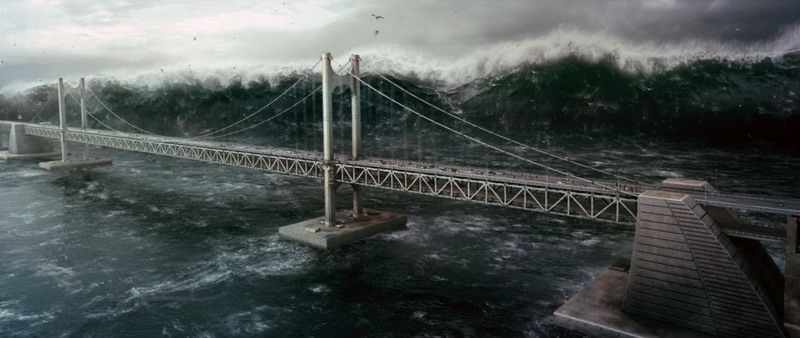
The transfer looks identical to the Korean version as far as I can tell. The high resolution showcases the natural colors of beautiful beach-scape and greatly enhances the realism of production design. I am doubtful, though, whether Blu Ray's heightened detail benefits our appreciation of CGI effects. Without the scope of the theater screen, the crashing tsunami is just not as spectacular as it should look. There might be some contrast issues, especially during the too-bright daylight sequences, but overall the transfer is excellent and probably superior to the prints used at the good majority of theatrical screenings. The five-channel DTS-HD tracks are available for both dubbed English and Korean language track. Tidal Wave just is not the same movie without the flurries of thick Busan accents floating around in the soundtrack. Having said this, the dubbed track is not too bad, also given that you get to hear Park Joong-hoon's English dialogue. The subtitles are above par in quality, although the dialogue, other than pseudo-scientific seismological details, is as hackneyed as you can imagine. The Blu Ray disc also contains a wealth of EPK materials with fairly good English subtitles (decidedly superior to the Tartan DVDs in the similar sections). Frankly quite a bit of them are boring and unless you are a visual effects enthusiast or a big fan of some of the cast members you are unlikely to have rollicking good time.
Other than the domestic Korean viewers who can crack up at a Busan nurse shouting "Poisoned!" and pronouncing it "Secret Karma!" (if you don't know the South-Kyongsang Province dialect, what I just wrote won't make a lick of sense), the only appropriate audience for Tidal Wave are thoroughly undiscriminating viewers of the mock-Hollywood disaster flicks, although Magnolia wins points for a sassy Blu Ray presentation.
Who says you can't have sweet revenge again?: VENGEANCE TRILOGY BOX-SET [DVD]
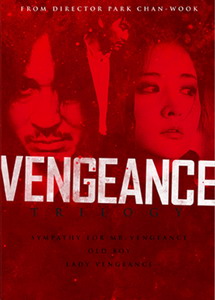 Tartan USA has received its share of criticism from the Asian film enthusiasts, especially those who wanted to see more of the likes of Hong Sang-soo, Lee Chang-dong and Im Sun-rye in the North American market than the latest crummy horror flicks, but the abrupt discontinuation of its "Asia Extreme" line was still sad news to many fans. Not to worry, Tartan has now merged with Palisades Films and resurrected itself, even reviving its "Asian Extreme" line. And of course, what better way to announce their triumphant return than a deluxe box-set of Park Chan-wook's "Revenge (Now for some reason-in order to appeal to the Eurocentric art-film cognoscenti?--called "Vengeance") Trilogy?" Anyone who has even cursorily visited this website should know my, shall I say, foundational status as an international Park Chan-wook fan (Harry Knowles's got nothing on me, brother), so I don't think these pages are hardly suitable forums for me to unspool my thoughts, recent or otherwise, on these three masterworks again--Sympathy for Mr. Vengeance (2002), Old Boy (2003) and Lady Vengeance (2005) (No longer referred to as Sympathy for Lady Vengeance, it seems). What y'all reading these pages want to know is whether this box-set warrants a double- or even triple-dip for those who own Region 3 DVDs or even Tartan's old releases. So that's exactly what you folks will get here: a review of the DVD presentations rather than of the movies themselves.
As soon as Palisades Tartan releases Blu Ray versions of these titles as they had promised, we will update the review accordingly. We know that the previously available Old Boy Blu Ray left a lot to be desired: hopefully they have addressed this issue.
DVD Presentation: Palisades Tartan. NTSC. Single Layer. Region 1. 8 discs. Release Date: March 16, 2010. Suggested Retail Price: $49.97. Disc 1: Sympathy for Mr. Vengeance. Video: Anamorphic Widescreen 2.35:1. Audio: Korean Dolby Digital 5.1, DTS Surround Sound 5.1. Subtitles: English, Spanish. Disc 2: Sympathy Supplementary Materials (Making-of film, Cast and Crew Interviews, etc). Disc 3: Old Boy. Video: Anamorphic Widescreen 2.35:1. Audio: Korean Dolby Digital 5.1, DTS Surround Sound 5.1. Subtitles: English, Spanish. Disc 4: Old Boy Supplementary Materials (Making-of film, Cast and Crew Interviews, Deleted Scenes, the Cannes Film Festival reportage, etc). Disc 5: Autobiography of Old Boy. Disc 6: Lady Vengeance. Video: Anamorphic Widescreen 2.35:1. Audio: Korean Dolby Digital 5.1, DTS Surround Sound 5.1. Subtitles: English, Spanish. Disc 7: "Fade to White" Version of Lady Vengeance. Disc 8: Lady Vengeance Supplementary Materials (Making-of film, Cast and Crew Interview, Deleted Scenes, etc.).
Palisades Tartan knows the significance of Park Chan-wook films in their film- and disco-graphic inventory very well. If they were to pull out all the stops in collectible DVDs, these three were undoubtedly the titles. Given this high expectation by the fandom, perhaps Tartan is facing a Sisyphus's struggle in satisfying their demands. Nonetheless, it is handy to keep all three films in one DVD set, packaged with all the available extra features faithfully imported from the old Region 3 releases, as well as some new supplements added, although their qualities vary. So let's take a plunge, first checking out feature films themselves and moving onto the supplements.
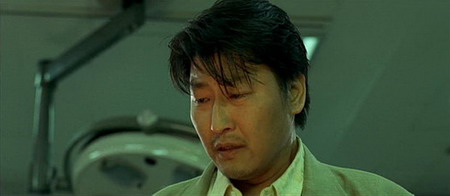 First off: Sympathy for Mr. Vengeance. The Sympathy transfer appears to be a close copy of the Korean Region 3 release, brighter, high-contrast, and leaning toward red and green, as opposed to the old Tartan Region 1 transfer, softer, darker, and noticeably stronger with blue and cyan. This shift in color timing is quite glaring, for instance, in a scene where Ryu (Shin Ha-gyun) sees the organ smugglers putting their advertisement tags on the bathroom stalls. In the old Tartan transfer, the cleaning lady's uniform appears rich, purple-like blue: in the box-set (and the Korean DVD) transfer, the bathroom stall doors are bright green, several shades more so than Ryu's dyed hair. Now this might be a welcome change for those who prefer this color scheme, but unfortunately, this does not mean an improvement in transfer quality. In fact, Sympathy's box-set version is more unstable than the old Tartan one, with aggressive aliases and other digital artifacts marring Ryu's checkered shirts and other images. Despite a color scheme more in line with the theatrical release (and possibly the director's intentions), this transfer cannot be called a significant improvement. This set's Sympathy also uses a different menu design from the old Tartan release, which annoyingly includes a major spoiler about the movie's ending. I recommend those who have not seen the film before to start the movie quickly without dwelling on the menu screen.
The box-set Old Boy, on the other hand, seems to be an exact or close replication of the old Tartan Region 1 transfer and retains its dark, softer, bluer look. Confusingly enough, this is not the color scheme used in Tartan's own Blu Ray release, which seems to be repossessing the greener, redder Region 3 hues. Old Boy DVDs have always been a major source of frustration for Korean film fans: it is true that the film sports much grungier, murkier look than the other two films in the trilogy but neither Region 1 and 3 (As this DVD Review page expands into the future, Region 2 discs will be added to the rosters, but I am afraid not at this point) releases have really done justice to the film.
To make things even more complicated, all three DVD versions of Lady Vengeance we inspected, the old Tartan release, the Region 3 CJ Entertainment issue and the current box-set version, feature different transfers. The Region 3 Korean disc, while high-caliber, is overcome by excessive contrast: some dark scenes have their details totally mashed, while any bright source of light-such as a naked-bulb overhead light-looks like a star has gone nova. The old Tartan release, while notably softer and warmer and expanding the palette considerably, is still infected by a goodly chunk of digital artifacts, including severe edge enhancement. The box-set transfer is by default the best of the three versions compared here, with the artifacts somewhat reduced and colors more sharpened than the old Tartan version. The menu screens are all different too, with the Region 3 version most beautiful and elaborate but again giving away portions of movie's content within its chapter compartments. DVD Beaver reports that the color version of Lady Vengeance has an encoding problem that prevents automatic default to the widescreen format: we have not encountered this problem at our Pioneer/Philips/Momitsu equipments, except during a playback in a laptop. (For the large-size screenshots comparing different versions, click here)
 As for the sound, all three movies come with the Dolby Digital 5-channel and DTS Surround tracks. They are quite robust and I am assuming the same mixes have been used all around, possibly except for Sympathy, where the Korean DVD seems to give more oomph to the ambient noises than both Tartan versions. The Old Boy disc starts off with a super-annoying, very low-resolution trailer for "Asia Extreme" titles, impervious to fast-forwarding.
Thankfully, English subtitles for Sympathy seem to have been re-done in some places, including a very welcome addition of the translations of written texts, such as the "Death Sentence" text that Young-mi (Bae Doo-na) is seen to be typing down in an earlier scene, a crucial plot point. Typos and grammatical errors still surface, however. Old Boy and Lady Vengeance subtitles seem to be more or less identical in all three versions, except in Lady Vengeance, again, the written texts are translated.
So bottom line as far as the A/V presentation is concerned, the box-set's Lady Vengeance gets a thumbs-up, Sympathy receives a different transfer but still problematic, and Old Boy, I am afraid, is all-round inadequate.
Now onto the supplements: Sympathy, in addition to Director Park Chan-wook and action film master Ryu Seung-wan's audio commentary carried over from the old Tartan release, adds several new extra features. First off is a confusingly titled "My Boksu Story (Boksu meaning "revenge" in Korean)," a string of cast interviews seemingly recorded one year or so after the Sympathy's theatrical release. Song Kang-ho as usual does not mince words, casually mentioning the dismal box-office failure of the film. The old making-of featurettes are crammed into "Original Behind the Scenes" sub-category: this section mostly deals with production notes and crew interviews. "Soundtracks and Photos" is a 13-minute long discussion of the avant-garde rock group Eo-eobu Project's music for the film. Also included are the requisite trailers and storyboard-to-the-film comparisons.
The most interesting special feature to the North American viewers is probably British journalist Jonathan Ross's profile of Park Chan-wook, produced for BBC in 2006. It does give Park some room to counter his "Western" critics and address popular misconceptions of his films, including the charge that they are too violent. The documentary is in English (Park's interview is overdubbed with English narration) and supports no subtitles. Needless to say, none of the extra features should be seen prior to watching the film itself, as even Ross's documentary are chock full of spoilers.
The English subtitles for the Korean-language Sympathy supplements, by the way, are simply dreadful. To give you some ideas, in various points of the "My Boksu Story," director Park Chan-wook is identified as "Park Chan-ho," his previous film JSA as "JSC," and Sin Ha-gyun's starring vehicle Save the Green Planet as "Keep the Earth." It really is like reading an undergraduate term paper written in 30 minutes after an all-night drinking orgy.
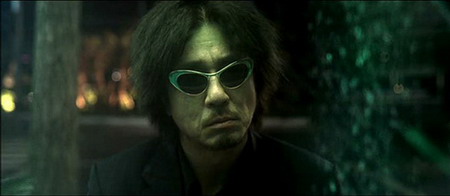
The Old Boy supplements reproduce the extensive Region 3 Special Edition features that cover all aspects of production, from pre-production design, casting, cinematography and music score to the post-production and marketing. The biggest chunk is set aside for the film's unique cast, with Gang Hye-jung easily the most striking presence. Yoo Ji-tae, in contrast, comes off as weird, with those strange-looking, red-tinted goggle glasses and pencil moustache. The featurette "Le Grand Prix at Cannes" is, unfortunately, a Korea-produced docu that celebrates Old Boy's win at Cannes Film Festival. It would have been far more interesting if some independent filmmaker was commissioned to examine the raw and unadulterated reactions of the foreign press, critics and viewers to Old Boy, although Park himself seems determined not to let all these brouhaha go to his head (Considering that he subsequently made I'm Cyborg and Thirst, he obviously succeeded). The second supplementary disc for Old Boy is something called "The Autobiography of Old Boy," a 34-minute-long video diary of the production, detailing the spectacular fight sequence taking place at the villain's penthouse, resulting in some shockingly gory shots. Throughout the docu Park Chan-wook demonstrates his eye for detail, gently urging Yoo Ji-tae to look at the right side of his cuff at one point. With minimum of editorializing, this is far more fascinating than other EPK pieces. Even though overall the supplementary materials are better organized and more plentiful compared to the case with Sympathy, there is very little that's new here for those who already own the Region 3 Special Edition DVD set.
 Next, the Lady Vengeance set probably contains the most desirable "supplement" for North American consumers in this set: Park Chan-wook's "fade-to-white" version of the film. Region 3 Special Edition did contain this feature but was only equipped with the DTS soundtrack. This version seems to be virtually identical to the Korean Region 3 transfer, a bit coarser and grainier than the main feature. It may well be that my eyes are playing tricks on me, but the editing seems to be tightened up in this version, too, almost on a subliminal level. The black-and-white visuals don't really kick in until the "jury as the executioners" sequence, and the transition is not as gradual as Park's introduction suggests. The monochromic visuals make this sequence appear more somber, tragic and somewhat surreal, than it is in the color version: more David Lynch than Martin Scorsese, if you will. It really depends on your taste which version you might prefer. Both "fade-to-white" and color versions are overlain with audio commentaries by Park, star Lee Yeong-ae, DP Chung Chung-hoon and Production Designer Cho Hwa-sung. The old Tartan commentary by Richard Pena of Columbia University is also carried over, a very good listen. The second supplementary disc contains exhaustive interviews with cast and crew members, making-of docus on, again, all aspects of production, deleted scenes and trailers. English subtitles, while not perfect, are substantially better than those provided for the Sympathy supplements.
Finally, the box-set includes a 32-page booklet, handsomely illustrated by photos on glossy black paper. Instead of inviting international critics to opine on the films, Palisades-Tartan recruited pro filmmakers, headlined by Eli Roth (Hostel), who basically takes credit for letting Harry Knowles find the mind-blowing cinematic gem that is Sympathy for Mr. Vengeance. Other contributors include the Tartan staff member Rick Stelow, producer Don Murphy (Apt Pupil, Natural Born Killers), stunt coordinator John Kreng and producer-director Susan Montford (producer of Shoot 'Em-Up). I loved most Kreng's take on Old Boy ("that movie did a mind job on me!") from the fight-choreographer's standpoint but each contributor gives an interesting personal take on why his or her choice among the Vengeance trilogy is the best. The booklet also includes a very brief interview with Park Chan-wook, originally published in Giant Robot magazine, attached at the end almost like an afterthought. The booklet, while not altogether too substantial, does add credence to the view that Park Chan-wook is really a filmmaker's filmmaker, a talent better appreciated by those in the same profession than by generic movie-goers.
The red-spattered box design for the entire set is rather cheap-looking, although the plastic fold-out cases (one case for each film and its supplementary materials) appear reasonably sturdy.
In sum, I recommend, with some reservations noted above, Palisades Tartan's Vengeance Trilogy box-set to those interested in Korean cinema either unfamiliar with the films or experienced one or two of them (Not sure about what they are all about? Check out the reviews in the main site). The value-for-price ratio is pretty good, given the internet discount reducing the price to as low as $30-plus. As for the serious fans of Park Chan-wook's oeuvre, if you already own all Region 3 Special Editions and Tartan releases of the trilogy, purchasing this box-set might not be a sound investment. On the other hand, if you have missed out Korean Special Editions and only own old Tartan titles, double-dip might be a tempting proposition.
* DVDs for review courtesy of Palisades Tartan
Good ol' boy in the bosom of the Great Leader: CROSSING THE LINE [DVD]
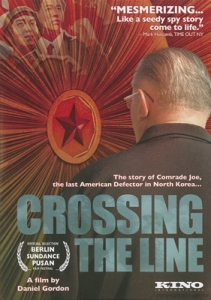 A Very Much So/Passion Film Production. 2006, United Kingdom, 1 hour 32 minutes. With participation of BBC, E Pictures, Koryo Tours, Cine Qua Non, Dongsoong Art Center. Directed by Daniel Gordon. Cinematography: Nick Bennet. Edited by Peter Haddon. Music by Heather Fenoughty. Sound edited by Stevie Haywood. Sound mixed by Adam Mendez. Sound effects by Samantha Storer. Narrated by Christian Slater.
In 2002, the BBC documentarian Daniel Gordon made a heartfelt and crowd-pleasing chronicle, The Game of Their Lives, of North Korea's football team and its incredible advance into the World Cup quarterfinals in 1966. Greatly pleased by the final product, North Korean authorities granted Gordon an unprecedented level of access for a foreign filmmaker, allowing him to record daily lives of two young girls preparing for an eye-poppingly grandiose (and for many people, obscenely totalitarian) "Mass Game" in celebration of the Great Leader Kim Jong Il. The resulting documentary, A State of Mind, sharply divided the viewer responses: some consider it nothing more than a detestable apologia for a quasi-monarchical dictatorship, while others see it as a refreshing corrective to the usual anti-Communist palavers that reduce North Koreans into little more than brainless termites. Instead of playing it safe for his next project, however, Gordon went ahead and tackled an even more potentially controversial topic--the life-story of Private James Drasnok, an American soldier who walked over the DMZ, riddled with uncharted mines, and "defected" to North Korea in 1962, and has lived there since. The result is one of the most fascinating documentaries about North Korea ever made: but the film also unexpectedly uncovers some truly interesting, even poignant, episodes of intersection between American and Korean histories.
Despite his somewhat heavy-handed effort to (visually) draw the parallel between the aggressively nationalistic cultures of North Korea and the United States, Gordon manages to keep afloat in the air disparate, often mutually incompatible, perspectives on the bizarre life history of Private Drasnok, ably navigating through the treacherous ideological waters. Certainly most North Koreans will be hard pressed to see "Crossing" as a negative portrayal of their own country (Kim Jong Il himself acknowledged abduction of Japanese citizens as a part of its insane "spy training" scheme in 2002, so discussing that issue is no longer officially discouraged), but those who insist on seeing North Korea as an oppressive totalitarian state will also find plenty of evidence here to back up their view. Perhaps the surest indication that Gordon has pulled off this difficult balancing act is that we as viewers cannot easily come to a conclusion about the film's protagonist.
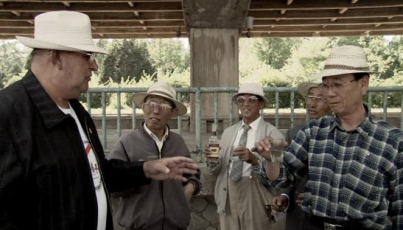 Drasnok's life is indeed the stuff that proves the adage "truth is stranger than fiction." A young Southern man, raised in poverty and a broken home (described by him as a "living hell"), he was a failure as a soldier as well. Cocky, ignorant and totally devoid of discipline, Drasnok crossed the DMZ seemingly out of sheer adolescent stupidity, like a teenager who has no loose change in his jeans pockets so decides to rob a liquor store, armed with a switchblade, and was as surprised as anyone when he was welcomed as a valuable tool for anti-American propaganda, eventually given a chance to lead a materially comfortable, middle-class life that surely would have been denied to him had he stayed in the U.S. (It might surprise some viewers to learn that North Korea was well ahead of South Korea in economic growth and overall quality of living conditions at least until mid-1960s, exceeding the average annual growth rate of 20 % in the years between 1954 and 1960)
Soon enough, he and his fellow U.S. army defectors (yes, there were more) fell into the pretty familiar routine of the annoying young American expats, cruising in a cluster, drinking, horsing around and chasing after women. The life in North Korea had begun to go sour by late 1960s: the Americans were unable to withstand the monotony of a "peaceful" Communist country and the lack of purpose in their lives. They finally attempted to jump ship to Europe via the Soviet embassy, which promptly sent them packing. Eventually, it was Comrade Kim Jong Il who came to their rescue, by casting Drasnok and his colleagues as seedy imperialist villains in his ambitious film productions. This portion of the documentary is simply amazing, as we are treated to rarely seen (certainly for me, never-before-seen) excerpts from such legendary North Korean megahits as Nameless Heroes, and footages of the American defectors hamming it up as hilariously grotesque caricatures of their own countrymen. Dresnok in these films suggests in appearance a no-talent cousin of Laird Cregar. Sargeant Charles Jenkins--Dresnok's arch-nemesis, resembling Ross Perot after a Jenny Craig diet regimen, more about him later--at one point shows up with a huge skullcap makeup, as if he is possessed by the Brain from Planet Arous: they must be seen to be believed.
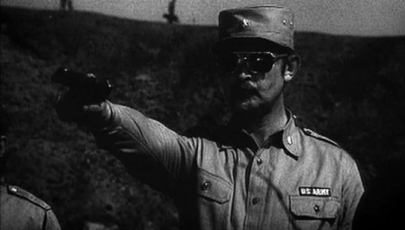 Equally amazing is Dresnok's family history. One neat trick Gordon pulls off is casting Dresnok and other defector's children as "actors" playing their fathers in a '60s black and white re-enactment sequence. Dresnok's son, James, half-American and half-Romanian, is a handsome, white young man, studying English in the prestigious Pyongyang Foreign Language University: it's positively unreal to hear James speaking in fluent Northern-accented Korean and then in halting Konglish for the interview. Dresnok's cute-as-a-button youngest son from his second marriage to a half-Somali Korean woman is one-quarter white, one-quarter African and half-Korean. So Dresnok's own family in the perhaps world's most ethnically and culturally homogeneous nation--as Professor Bruce Cumings points out, that never wavers in the belief that "Koreans are the most superior people on the planet"--turns out to be many degrees more multiethnic than a typical American one.
The docu abounds with such ironies scaling the height of surrealism, not the least of which is the fact that Dresnok still resolutely remains such an unreconstructed "American," shoveling bonhomie in thick Southern drawl, teaching NK students English as a "native speaker" (this will sound very familiar to many South Korean students) enjoying illegal fishing expeditions, and hailed by old Koreans who recognize "Arthur the Evil American" from the movies. One cannot help think that it was his quintessential qualities as an American, which made him a misfit in the U.S. army, helped him survive and even flourish in North Korea.
In the latter half, considerable dramatic tension is generated when Sergeant Jenkins chose in 2004 to leave North Korea with his two daughters and join his wife already in Japan, and authored an autobiography condemning North Korean regime (translated into English and published from University of California Press). Dresnok angrily rebuts much of the claim made in Jenkins' account of how the defectors were treated, including the claim that NK officials scorched tattoos on their bodies as a part of re-education procedure (according to him, the burning of tattoos was a strictly voluntary act). It's clear that underlying the politically charged mutual denunciations is a longstanding feud between Jenkins and Dresnok that seems to hark back to the 1960s: Dresnok relates with pride a story of beating Jenkins up when the latter tried to pull his rank on the former.
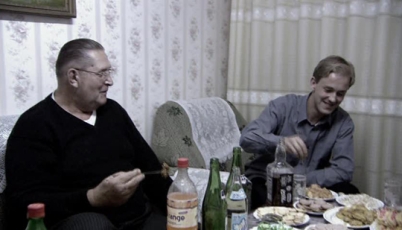 In the end, we are left with Dresnok's sly, gold-capped smile. Like all good documentaries, by showing an organically linked whole of the elements that are at first glance totally incompatible with one another and deftly maneuvering out from ideological agendas of its principals, Crossing the Line re-focuses our attention to the human foibles and ingenuity usually swept beneath the grand narratives of ideological struggles and national conflicts. I most certainly wouldn't buy a used car from Dresnok, but at the same time he is way too uncomfortably "ordinary American" for many viewers to be dismissed as a devious traitor or a mouthpiece for socialist ideals. It is not difficult at all to imagine him voting for Mike Huckabee in the Republican primary, had he lived in the States. The Novel Prize winning writer Orhan Pamuk once stated to the effect that the real task of an artist is to show the people so utterly divided by language, culture, custom and beliefs are, in fact, exactly the same at their core. Whatever your opinion may be about this docu, and many viewers will come away from watching it with their negative views about North Korea confirmed, or even reinforced, I have no doubt that it achieved its artistic (and humanistic) aim in this sense.
DVD Presentation:
Kino Video(US). NTSC. Single Layer. Region 1. Video: Anamorphic Widescreen 1.85:1. Audio: Korean and English Dolby Digital 2.0. Subtitles: English. Supplements: An interview with director Daniel Gordon, photo galleries.
Kino Video is not exactly 100% reliable in terms of quality presentation of foreign titles, but Crossing the Line's predominantly HD-lensed visuals are shown in a reasonably attractive fashion. Considering the large number of archival footage, the quality of video fluctuates wildly, especially in the first half, but I haven't noticed any significant transfer problem. The soundtrack is quite ordinary: the techno-minimalist music score sounds a little tinny, but it serves the purpose. The only substantial supplementary material is a 30-minute interview with the director. It is informative but the questions basically make him re-cap the film in a digest form, so it will be a total spoiler for those who haven't seen the main feature. I'd like to know why Christian Slater was chosen to narrate the film: maybe Gordon explains it and I missed it.